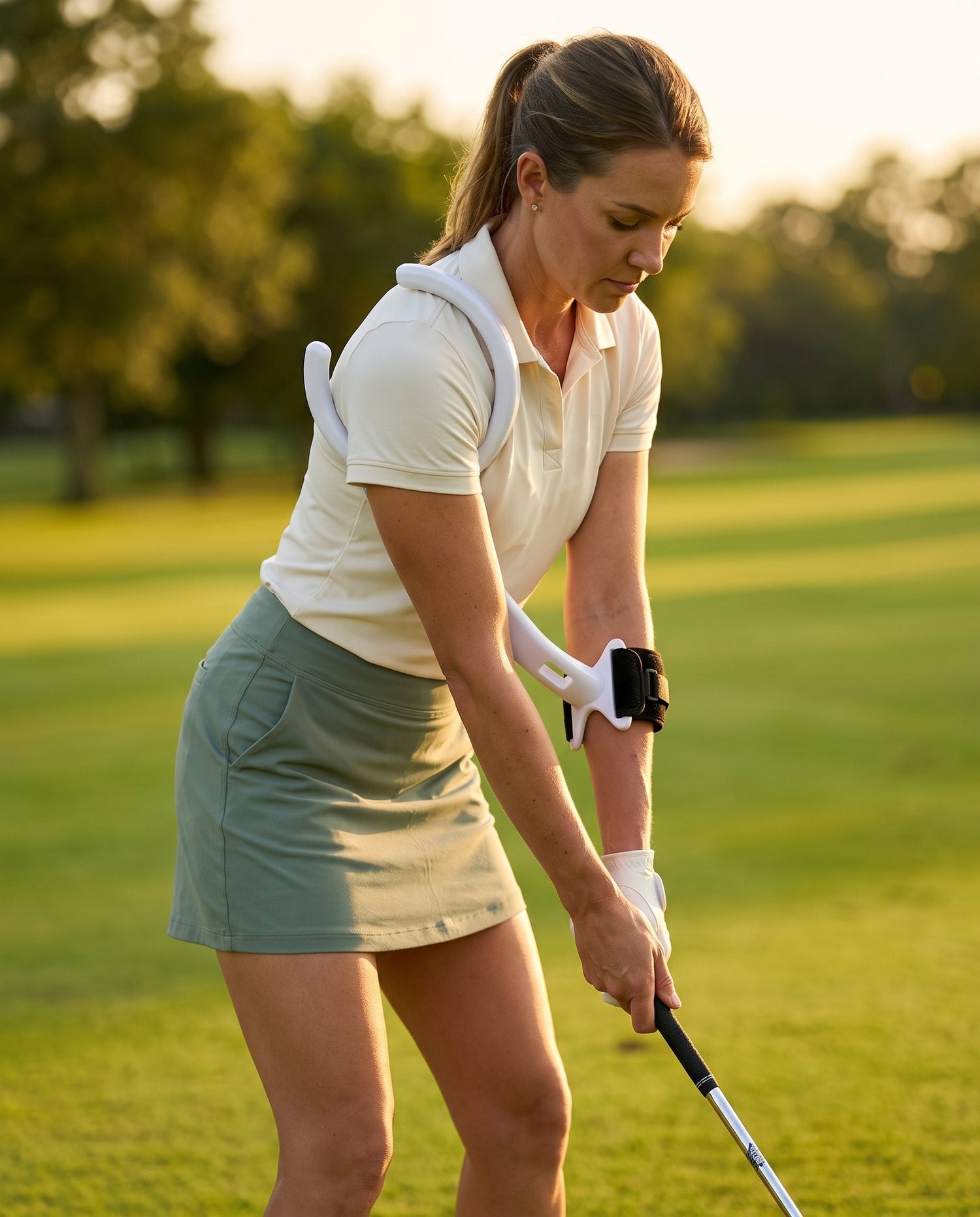
Home practice has one enormous advantage over the range: frequency. Ten minutes on five evenings beats one long Saturday session, because motor learning depends on repetition spread across days, not volume crammed into one.
The catch is that most training aids assume you are hitting balls. These do not.
Connection work, no ball needed
Arm connection is the ideal home skill, because it is trained in slow rehearsal swings rather than full shots. Put a band around your upper arms or a ball between your forearms, make half swings in a hallway, and take it off. Nothing leaves the floor and the feel still builds. The Sync Band and Sync Ball were both designed for exactly this.
Putting, which is where the strokes are anyway
Putting is the one part of the game that transfers almost perfectly from carpet to green in terms of stroke mechanics. Setup, eye line and shoulder alignment are identical indoors. A mirror such as TrueRoll gives you the same information on a rug that it gives on a practice green.
Mirror work with no equipment at all
Stand in front of any full-length mirror, cross your arms over your chest and turn back and through. Two minutes. You are burning in the correct picture of the body moving as one unit, and it costs nothing.
What does not work indoors
- Anything requiring full speed swings in a normal room. Ceilings are unforgiving and so are light fittings.
- Path and strike work that needs to see ball flight.
- Speed training, unless you have real space.
A ten minute evening routine
- Two minutes of mirror turns, arms crossed.
- Five minutes of slow connection reps with a band or ball, then the same swings with it off.
- Three minutes of short putts over an alignment reference.
Do that five evenings a week and you will arrive at the weekend having practised more than most people at the range.